Why ERW Credit Quality is Too High
December 15, 2025

How ERW Credit Quality Is Determined
One key measure of carbon removal credit quality is the likelihood that any issued credit corresponds to at least one additional tonne of CO₂ equivalent removed from the atmosphere.
That likelihood can be increased in several ways: through higher-quality measurement, more extensive and conservative protocols, or larger uncertainty discounts. Each of these approaches improves credit integrity—but always at a cost. Understanding how these trade-offs affect both credit quality and project economics is highly non-trivial. ERW protocols alone span hundreds of pages and contain many non-linear relationships between sampling density, uncertainty, validation rules, and credit issuance.
To better understand these dynamics—and to quantify the potential impact of Pulsar, our new alkalinity efflux sensor designed to increase measurement quality while lowering cost—we built a comprehensive ERW project modeling tool. After reviewing three leading standards across 445 pages of documentation, we reduced them to three coherent sets of rules, calculations, and probability functions that can be explored interactively.
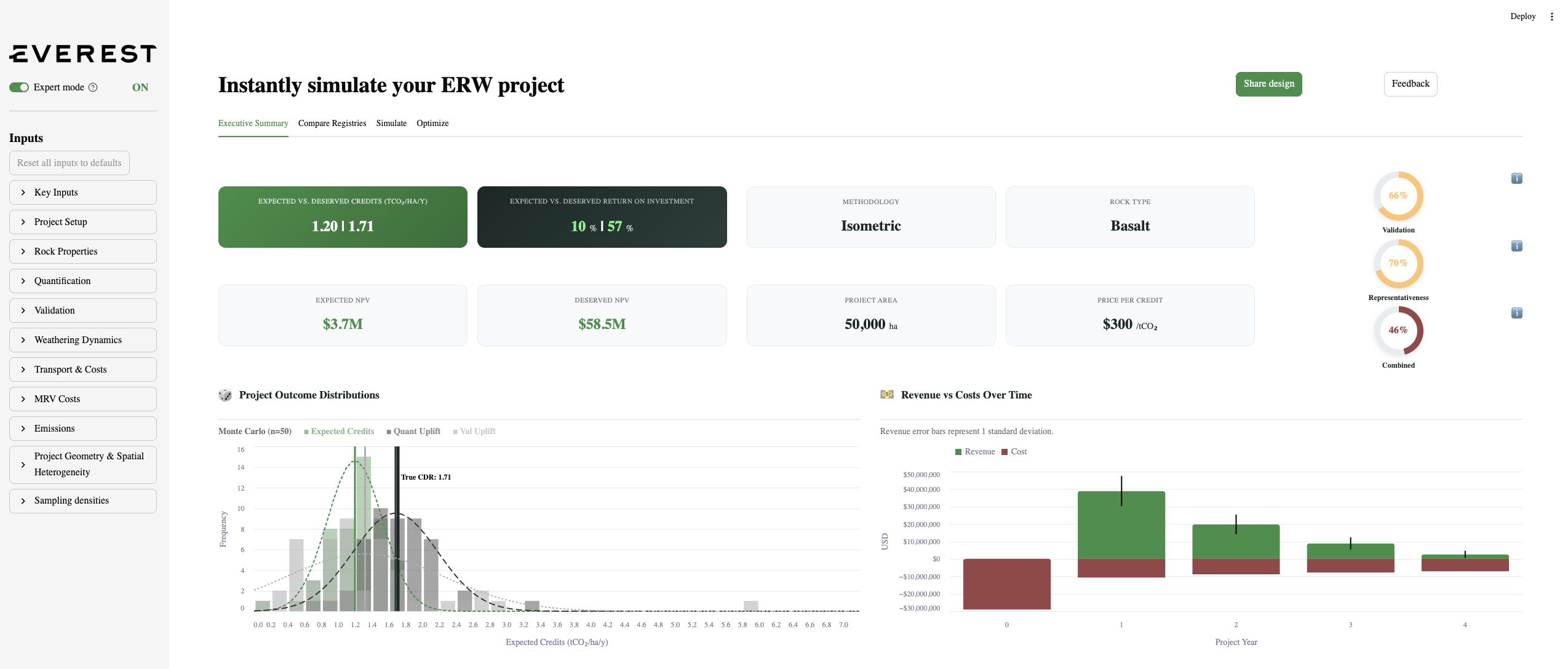
If you are interested in the mathematical structure behind these models, we provide a detailed walkthrough in a separate technical post.
We have learned so much from this tool that we decided to make it public. Our goal is to accelerate industry learning and alignment:
- Project developers can test how measurement types, sampling density, and field conditions affect outcomes.
- Standards bodies can explore how specific rules influence over- or under-crediting risk.
- Credit buyers can better understand how different standards and projects align with their quality thresholds.
- Investors can independently assess expected project returns and downside risk.
- Policy makers can build confidence around the integration of ERW into compliance markets.
One conclusion stood out clearly: the only viable path to gigatonne-scale ERW is more effective and more affordable measurement, enabling lower uncertainty discounts and lower costs under existing standards.
What ERW Credit Quality Looks Like Today
The ERW industry has followed a familiar trajectory seen across other carbon removal pathways:
- Academics demonstrate theoretical potential.
- Entrepreneurs prove technical viability.
- Standards bodies establish market credibility.
The third step is the hardest. Credibility must be earned under conditions of profound uncertainty—and can be lost instantly.
ERW takes place in open systems. Spatial heterogeneity, spreading variability, temporal fluctuations, and measurement uncertainty all affect observed outcomes. The simplest way to reduce variance is to increase sampling density, but this quickly renders projects uneconomic. Standards therefore face a fundamental tension: allowing enough uncertainty to enable viable projects, while preventing structural over-crediting.
A key concern is bias, which can arise in several ways:
- Measurement tools that systematically overestimate drawdown
- Favorable site selection that inflates treatment–control differences
- Statistical asymmetry, where false positives generate credits but false negatives do not generate penalties
Without careful design, noise alone could produce credits over time.
To mitigate these risks, standards bodies have done substantial work to design conservative protocols. These include strict validation rules, representativeness tests, and uncertainty discounts. The result is a system that, despite remaining uncertainty, produces extremely high-integrity credits.
The distributions below illustrate modeled outcomes for a single representative scenario using today’s most common ERW measurement approaches. While only one of many possible scenarios, the pattern is consistent across much of the parameter space we explored.
The main takeaway: expected credited volumes are often significantly lower than true CDR generated. This outcome is highly assumption-dependent—but given the width of current uncertainty distributions, the conservatism applied by standards is justified.
Credibility has been established. For that, the industry owes standards bodies a big thanks.
The next challenge is enabling credited volumes to approach true CDR without compromising integrity.
How Credit Quality Constrains ERW Scale
Bringing large pools of capital into ERW is the final step toward climate-relevant scale—and that requires a maturing credit market:
- Credit issuance enables broader demand
- Protocol refinement reduces friction
- Economic opportunity attracts capital
InPlanet’s early issuances under Isometric marked an important milestone. Since then, Eion, Lithos, and AltCarbon have followed under Isometric and Puro, with more projects expected soon. Demand is accelerating, and ERW is increasingly visible beyond the carbon removal community. Through the work of the Enhanced Weathering Alliance, ERW is now being considered for inclusion in the EU Carbon Removal Certification Framework.
Mass-market demand is coming
What mass-market adoption requires, however, are credit prices competitive with other pathways, such as biochar. Based on our modeling, achieving prices in the ~$150/tCO₂e range appears unlikely under current measurement approaches and existing protocols. Credit quality is effectively too high: under-crediting forces developers to charge higher prices to recover costs.
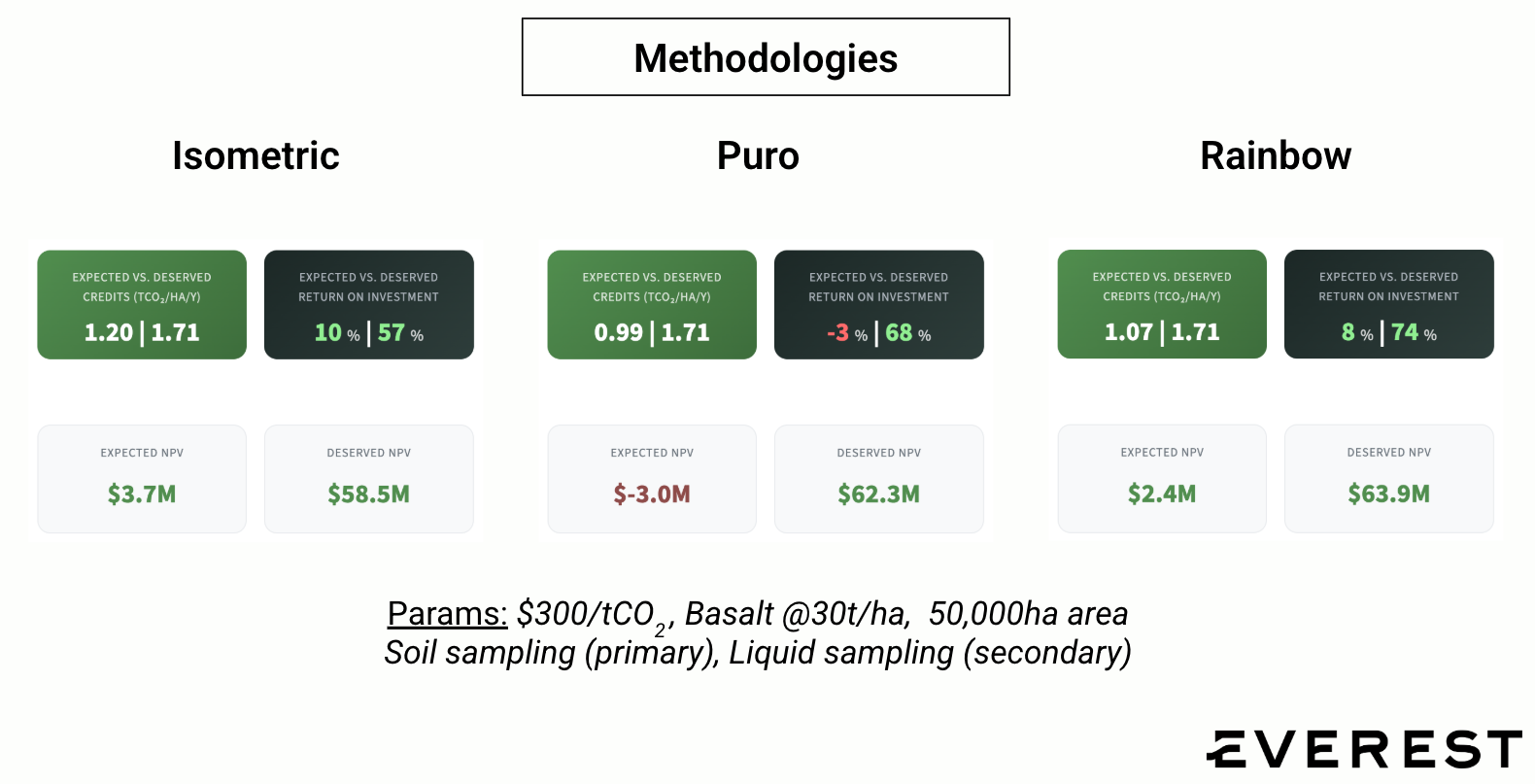
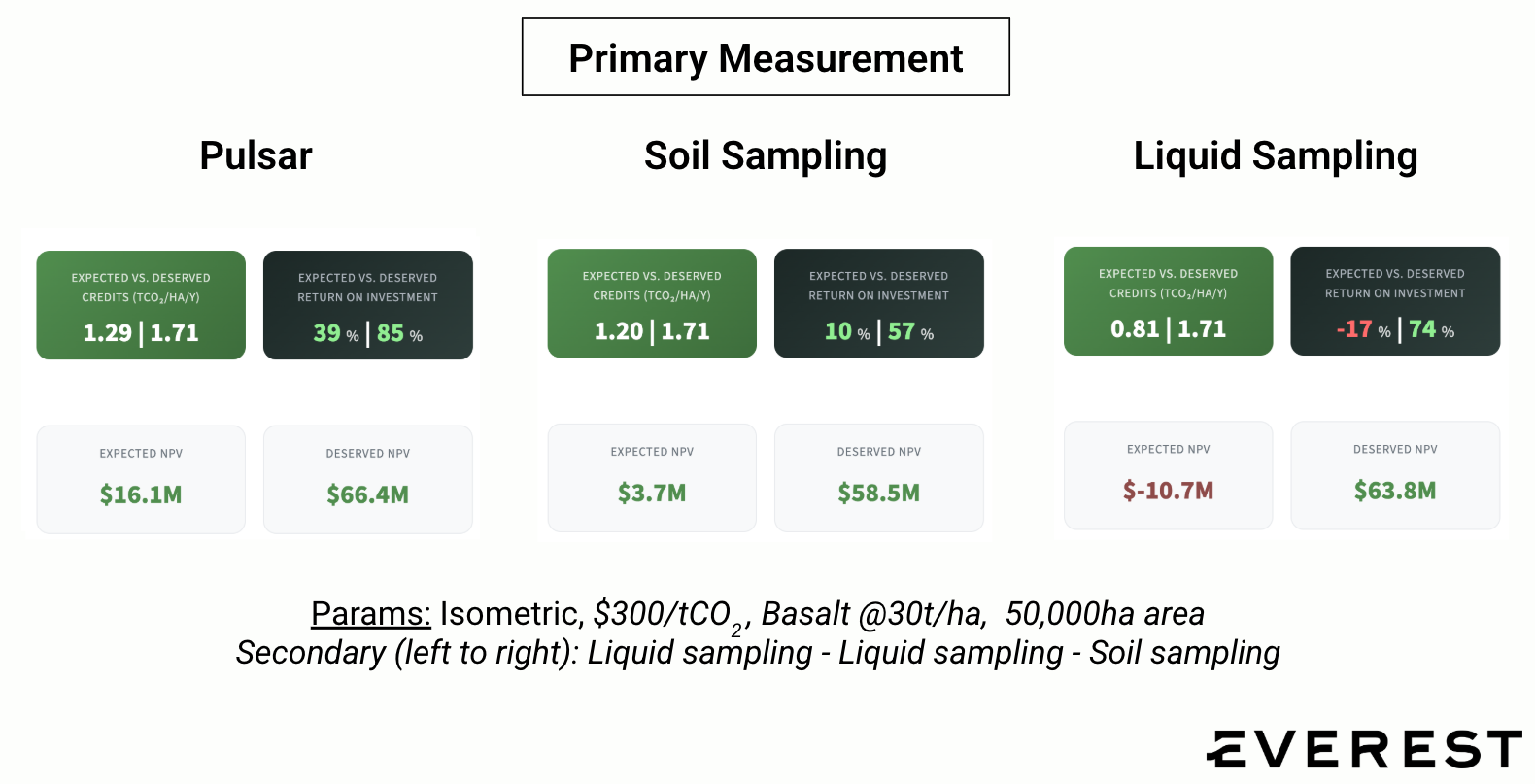
Translating Pulsar’s recently published lab performance to field conditions—and continuing down the sensor cost curve—fundamentally changes these outcomes. By directly measuring cumulative alkalinity flux in situ, Pulsar reduces key sources of measurement noise that drive conservative discounts in current ERW methodologies. Lower uncertainty increases the expected share of credited CO₂ removal, all else being equal, while replacing labor- and sampling-intensive workflows with a low-cost, continuous measurement system. The combined effect of higher expected credits and lower core MRV costs materially improves project economics across methodologies.
The Central Role of Measurement in ERW Crediting
Improved measurement does more than increase credited volumes under current standards. It enables standards themselves to simplify, reducing the need for heavy uncertainty haircuts and complex validation structures. Lower uncertainty drives lower costs, which enables lower prices. Lower prices unlock mass-market demand. Capital follows demand. Economies of scale get unlocked, further driving down cost.
This is the flywheel required for gigatonne-scale ERW. In the meantime, early buyers such as Microsoft and Frontier are actively helping buy the industry down the cost curve. Their role cannot be overstated and should not be taken for granted while waiting for the mass market to scale.
Building this model reinforced our conviction that measurement is the limiting factor for ERW today. The ecosystem already includes world-class project developers, buyers, researchers, and investors. What is still missing are tools that replace manual sampling and guesswork with predictable, digitized operations. In this context, we recently reported the performance of Everest Pulsar, our third-generation in-situ alkalinity sensor, in a preprint that demonstrates order-of-magnitude reductions in both measurement uncertainty and core MRV cost relative to current ERW approaches. Based on our simulations, achieving prices in the ~$150/tCO₂ range appears challenging under current measurement approaches and existing protocols.
Don’t take our word for it. Explore the model yourself—and share your learnings, feedback, and feature requests with us!
Share this post


Blogs